Something is asking for your attention.
Conversation Branches
Some conversations do not stay put. You replay them, revise them, anticipate them, and discover that one line can change the whole shape of what follows. A linear note is often too flat for that kind of work.
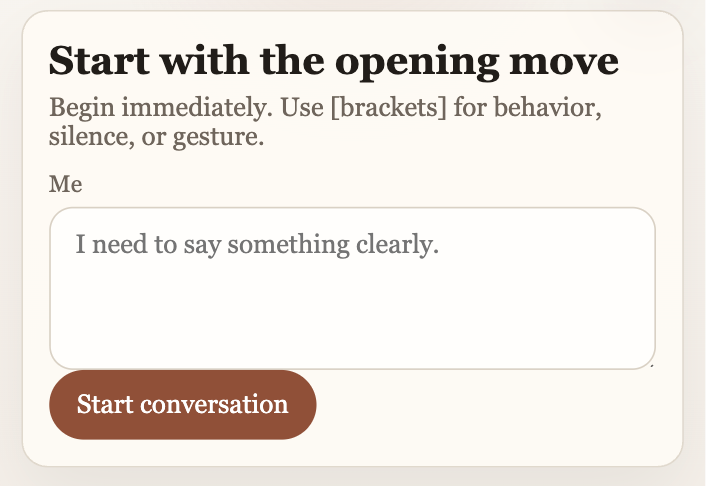
Conversation Branches is a small local-first web app for writing difficult conversations as branching possibilities rather than a single script. You begin with an opening move, then add possible replies, then replies to those replies. The result is not analysis by a machine, but a more stable way of seeing what different turns might make possible.
What it is for
Use it when you are preparing for a difficult conversation, revisiting one that did not go as you hoped, or trying to understand how an exchange changes when the wording becomes firmer, softer, more evasive, more honest, or unexpectedly kind.
It can also be useful for working through a conversation that is no longer actually possible and yet still feels unfinished. Sometimes the other person is gone, unavailable, unwilling, or the moment itself has passed. Even so, the exchange continues to exert pressure in thought. Writing several possible turns can help clarify what was being asked, avoided, or never said without pretending the conversation can now be repaired by technique.
The tool lets you write not only speech, but also pauses, gestures, withdrawal, or other nonverbal moments by using bracketed text such as [long pause] or [looks away]. That matters because real conversations are not made of words alone.
Why this format helps
Most people rehearse hard conversations internally in unstable loops. Branching the exchange gives that rehearsal a visible structure. Instead of forcing yourself to choose one imagined outcome too quickly, you can preserve the forks:
- how the other person might respond
- how you might answer in return
- where the exchange predictably derails
- what changes when one sentence is altered
Why I am offering it here
This tool fits the larger concern of this section. We are situated persons, not floating profiles. Our lives are shaped by concrete relationships, actual histories, real speech, and the way a moment unfolds between embodied people. A tool that helps you think through a real conversation is one way of taking that seriously.